


It is understandable that owners converting their own bicycles with Bafang BBS motors are uncertain about the rules. Many guides mix up road traffic law, technical standards, product safety law and the duties of manufacturers. These are different questions and should be addressed separately.
When is a converted bicycle a pedelec rather than a motor vehicle?
For classification under road traffic law, the actual technical condition of the vehicle is decisive. If it meets the criteria of Section 1(3) of the German Road Traffic Act (StVG), it is expressly not a motor vehicle within the meaning of that Act; bicycle rules apply.
A private conversion does not automatically create a motor vehicle
In principle, an ordinary bicycle may be converted into a pedelec. The Research Services of the German Bundestag have also expressly discussed this in their briefing on the legal regulation of pedelecs.
The decisive question for road traffic classification is not whether the motor was originally supplied as a retrofit kit or whether an operating limit was subsequently established by a technical measure. What matters is the actual characteristics of the finished vehicle in its real operating state.
The statutory conditions for classification as a bicycle arise from road traffic law, particularly Section 1(3) StVG and Section 63a of the German Road Traffic Licensing Regulations (StVZO).
Further reading: vehicle classes and the statutory definition of a pedelec.
250 watts means rated continuous power — not simply peak power
Discussions about the power of Bafang BBS systems frequently cause confusion. The statutory limit concerns rated continuous power, not every short-duration electrical power reading.
Voltage, motor current, efficiency, thermal operating state, controller parameters and actual mechanical output must not simply be treated as interchangeable values.
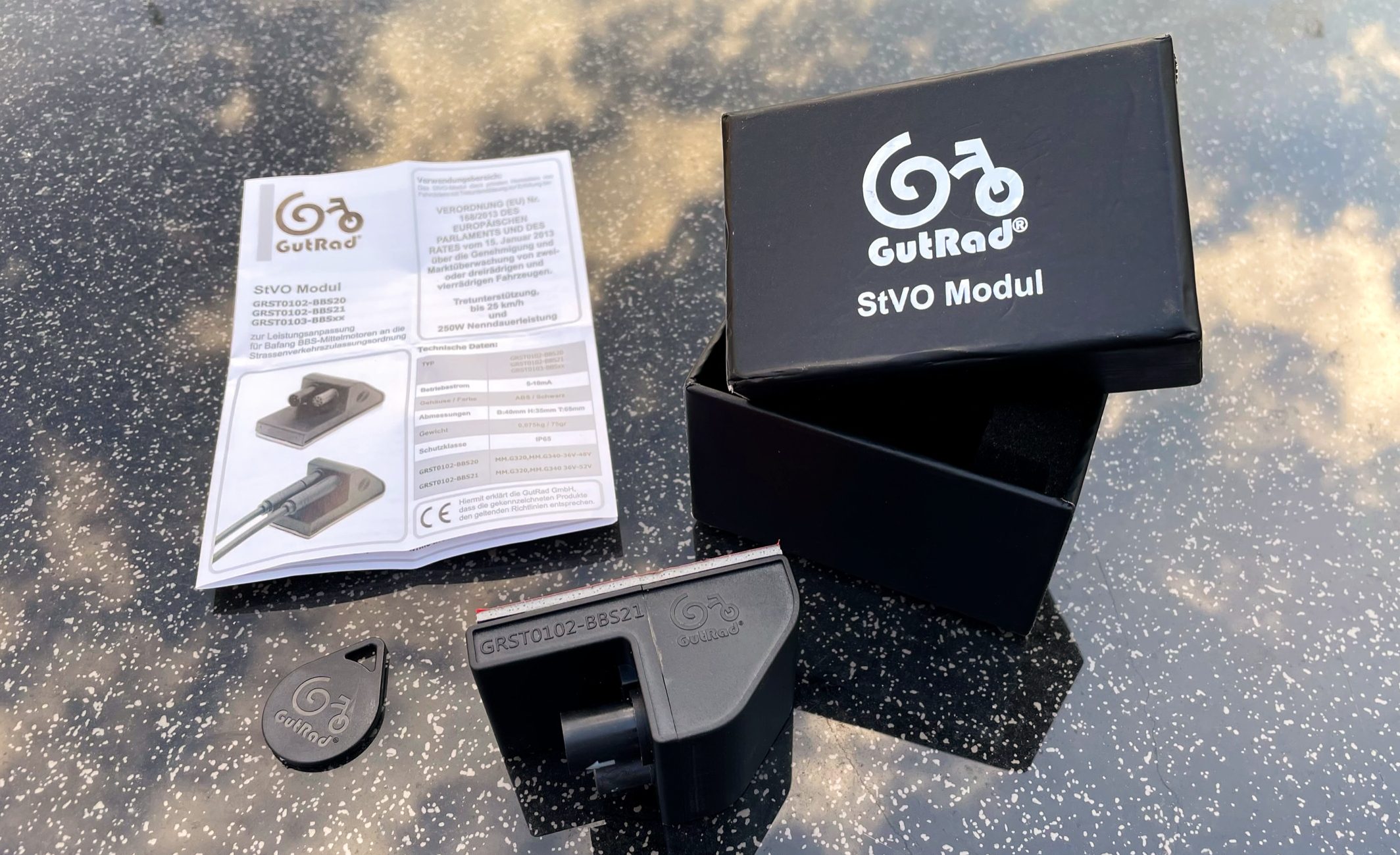
For each intended motor profile, the GutRad StVO Module applies and monitors a defined current limit. That limit is matched to the intended 250 W rated-continuous-power operation of the respective Bafang BBS system.
Further reading: how rated continuous power should be understood for Bafang BBS mid-drive motors.
Why simply programming a controller is not the same
Bafang BBS controllers can generally be configured. Depending on the system, settings can be changed through a programming cable or compatible control solutions may offer different riding profiles.
This matters for legal assessment because the values displayed during one inspection are not the only consideration. It may also matter whether the limits relevant to pedelec operation can subsequently be changed or bypassed during ordinary use.
This is where the GutRad StVO Module comes in
The module is not simply a speed display or a setting in the display. When used correctly, it can create the technical basis for a defined and reproducible pedelec operating state.
On compatible Bafang BBS configurations, this includes:
- limiting and monitoring motor current to correspond to intended 250 W rated continuous power;
- limiting motor assistance to no more than 25 km/h;
- linking normal motor assistance to pedal movement;
- limiting any starting or walk assistance to no more than 6 km/h.
Protection against manipulation is more than a number on the display
The important distinction from a freely programmable Bafang BBS configuration is that the limits imposed by the StVO Module cannot simply be changed beyond statutory requirements while riding by using the display, an app or a concealed switch.
The concept is also intended to prevent switching between a pedelec profile and a profile allowing increased speed or output during operation.
With freely programmable systems, controller parameters can be changed using a programming cable. Compatible devices such as an EggRider display may also permit different ride profiles.
What role does DIN EN 15194 play?
Two areas of law are frequently confused at this point. DIN EN 15194 is a technical standard for electrically power-assisted cycles. It is not the statutory definition of a pedelec under the StVG.
Section 1(3) StVG does not require an “EN 15194 sticker” or an EN 15194 certificate number as the condition for classification as a bicycle under road traffic law.
The standard plays an important role in product safety, conformity assessment and demonstrating technical safety requirements.
This concerns the statutory vehicle characteristics: rated continuous power, pedal assistance and assistance cut-off speed.
This includes safety requirements, conformity assessment, technical documentation and CE marking.
These two levels must not be treated as identical.
Converting your own bicycle and manufacturing for others are different situations
It is particularly problematic to draw broad conclusions about commercial manufacture from the question of a private DIY conversion, or vice versa.
Anyone who manufactures a completed converted bicycle for another person or places such a product on the market in the course of business must consider the relevant manufacturer’s and conformity obligations. These may include technical documentation, risk assessment, conformity assessment, a declaration of conformity and CE marking.
Conversely, that does not mean a privately converted bicycle automatically becomes a motor vehicle requiring approval solely because it lacks an EN 15194 test report. Product law and road traffic classification must be assessed separately.
What does this mean for the StVO Module on BBS UART?
The GutRad StVO Module is not merely a “25 km/h switch”. Its role on a compatible Bafang BBS UART configuration is to establish a defined operating state and limit or monitor the relevant parameters.
When correctly used, the module can help provide the technical conditions for the Bafang BBS UART drive to remain within its intended pedelec operating range. This particularly concerns the rated-continuous-power limit implemented through the relevant current profile, the 25 km/h assistance cut-off, pedal-dependent assistance and the limit on starting/walk assistance.
Further reading: how the GutRad StVO Module works with Bafang BBS UART.
And what does this look like in practice?
GutRad is not aware of a case in which a correctly used StVO Module was specifically objected to because of the module itself. This cannot provide a guarantee in every possible case. It does illustrate why a reproducible, technically defined operating state may make an important practical difference compared with controller settings that can be freely changed at any time.
A 250 W sticker does not solve the problem
A vehicle does not acquire its legal classification because “250 W” is printed on its motor housing. Nor is it sufficient to temporarily reduce a more powerful operating configuration for an inspection. The actual and intended technical condition of the complete vehicle is decisive.
Further reading: why a 250 W sticker and controller programming are not equivalent to a defined pedelec operating state.
Four things must not be confused
- Pedelec classification: determined by the statutory technical characteristics of the vehicle.
- DIN EN 15194: a technical standard, not the StVG definition of a pedelec.
- Manufacturer obligations: a separate area of law, particularly relevant to manufacturing, placing on the market and putting into service.
- StVO Module: when correctly used, it can provide the technical basis for a defined, monitored pedelec state protected against simple switching during operation.
Legal bases and references
- Section 1(3) German Road Traffic Act (StVG)
- Section 63a German Road Traffic Licensing Regulations (StVZO)
- Article 2(2)(h), Regulation (EU) No 168/2013
- 9th German Product Safety Ordinance (Machinery Ordinance)
- Directive 2006/42/EC on machinery
- DIN EN 15194 — EPACs
- German Bundestag Research Services: “Gesetzliche Regulierung von Pedelecs”, WD 5 – 3000 – 042/24
Legal position as at September 2026. The then-current German 9th Product Safety Ordinance ceases to apply at the end of 19 January 2027; from 20 January 2027, the new EU Machinery Regulation (EU) 2023/1230 largely applies.
This article describes general technical and legal matters. It is not a substitute for legal advice on an individual case.


