


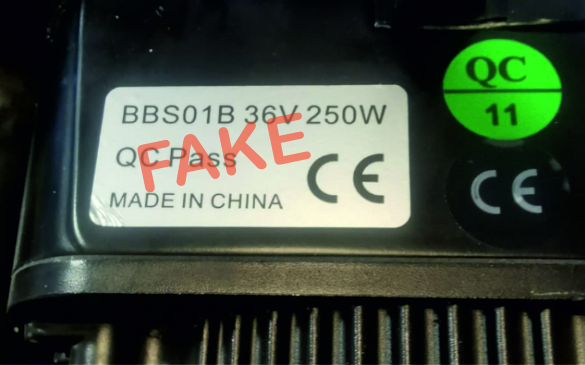
Does a 250 W sticker automatically make a Bafang BBS bicycle a pedelec?
No. A 250 W sticker alone does not determine whether a bicycle converted with a Bafang BBS can legally be classified as a bicycle or pedelec. Equally, a higher short-term electrical power draw does not automatically mean that a drive cannot be used in a pedelec. What matters is the actual technical characteristics of the completed vehicle.
What does Section 1(3) of the German Road Traffic Act (StVG) require?
For a bicycle with an auxiliary electric motor, the German Road Traffic Act specifies in particular:
- no more than 250 W rated continuous power;
- progressive reduction in assistance as speed increases;
- assistance ending no later than 25 km/h;
- motor assistance ending when the rider stops pedalling.
Starting or walk assistance of up to 6 km/h may also be fitted. The decisive factor is therefore not a number printed on the housing or a label, but the way the system actually operates.
Is programming a Bafang BBS controller prohibited?
Changing controller parameters is not automatically prohibited simply because programming software is used. The key questions are what operating state is created and how the vehicle is subsequently used. An entered 25 km/h limit or a 250 W value is not, by itself, proof that all requirements relevant to the finished bicycle have been met.
Why a 250 W sticker is not proof of power
The legally relevant figure is rated continuous power. A sticker added afterwards does not measure power, monitor controller data or prevent future configuration changes. A sticker may at most describe an actual technical state; it cannot create that state. A false or misleading label does not make a non-compliant configuration compliant.
CE marking and a 250 W rating are different issues
CE marking is not an official vehicle approval for a pedelec. By applying CE marking, the manufacturer responsible for the product declares conformity with the European requirements applicable to that particular product. Which regulations a particular CE mark covers can only be assessed from the relevant declaration of conformity and technical documentation.
A CE mark on one component does not automatically establish that the completed conversion meets all pedelec requirements. Conversely, CE marking must not be equated with government-issued vehicle approval.
A certificate does not itself make a vehicle exempt from approval
A written statement, data sheet or other technical documentation does not create pedelec status. Classification depends on the vehicle’s actual properties. Documents can, however, help explain and substantiate its technical state. The blanket statement that a vehicle automatically requires approval without a manufacturer’s certificate is therefore too simplistic.
What is the real problem with freely programmable BBS systems?
Relevant parameters on compatible Bafang BBS UART controllers can generally be changed. A one-off programming operation therefore does not answer what happens if the settings are later changed again. That is the central issue for GutRad.
What does the GutRad StVO Module do?
The GutRad StVO Module establishes a defined GutRad parameter set for compatible Bafang BBS UART systems. It saves the existing controller data before the initial adjustment and checks relevant parameters each time the system starts. If deviations are detected, the module overwrites the affected values with the saved GutRad set. This is different from programming a controller only once.
Why we avoid simply calling it “tamper-proof”
“Tamper-proof” is too broad a technical claim. We prefer to describe exactly what the system does: changes to monitored controller parameters are detected at the next startup and overwritten using the stored GutRad parameter set.
The GutRad Key is not a tuning switch
The GutRad Key is not necessary during normal intended use. It is primarily intended to restore the controller data backed up before installation, for example when removing or returning the module. It is not designed to switch between pedelec and tuning modes.
Who is responsible for a DIY conversion?
Anyone fitting a retrofit motor to a bicycle remains responsible for the technically safe condition of the completed vehicle. This includes not only controller settings, but also installation and the bicycle’s other safety-relevant characteristics. The GutRad StVO Module does not take on responsibility for the whole vehicle. GutRad documents the operating state established and monitored by its system for the compatible drive — no more and no less.
Conclusion: sticker, software setting and actual operating state
Three concepts must be kept separate when classifying a Bafang BBS DIY conversion:
- Sticker: at most describes a stated value.
- Programming: sets controller parameters at a particular point in time.
- Actual operating state: determines how the drive really functions.
What matters is not what is printed on the motor, but what the system actually does.
Further information
- GutRad StVO Module: Function, Monitoring and Responsibility
- How the GutRad StVO Module works
- Bafang BBS DIY conversion: Pedelec Status and Responsibility
- Section 1 StVG — official German legislation
- GutRad StVO Module in the shop
This article provides general technical and legal information, not individual legal advice or an assessment of a specific vehicle.


