Bafang BBS Controller Firmware Updates Available Online

Shop.GutRad.Com BESST

Firmware updates for Bafang BBS motors, and controller programming using a programming cable, SpeedApp or other tools.

If you follow instructions found online or incorrect advice from specialist forums to carry out supposedly “simple” parameter changes or a firmware update on your Bafang BBS controller, you risk damaging the hardware. Such damage may involve costs in the hundreds of euros and usually requires considerable work to repair.

Seek competent, specialist advice instead to avoid unnecessary expense and lost time. Spend more time riding your bike than repairing it in the workshop.

Choosing the Right Bottom Bracket Width for a Bafang BBSHD

The BBSHD 1000 W is described here as the most powerful variant in the Bafang mid-drive series, with a torque rating of 160 Nm. This motor is designed for retrofitting bicycles with different bottom bracket widths, from 68 mm to 120 mm. By comparison, the BBS01 and BBS02 are intended for bottom brackets up to 73 mm wide.

Many bicycle owners ask: “Which Bafang BBS motor will fit my bicycle?” Often, the answer is: “It is difficult to say without checking.” The wide range of bicycle models and their specific requirements makes a definitive answer difficult.

For this reason, an important part of our work is helping customers select the appropriate Bafang motor components and accessories so that installation can proceed as smoothly as possible.

Retrofitting a mid-drive system from the Bafang BBS range to an existing bicycle is a technical task that the person carrying out the conversion must manage. Fortunately, there is a great deal of guidance and information available, including for beginners.

Problems often arise when enthusiasts begin a project without enough research or preparation. Because requirements differ from one bicycle to another, there is no universal solution. Careful planning is essential.

This article is intended to help you choose the correct parts the first time and avoid expensive shipping costs and delays caused by ordering unsuitable components. We offer individual advice to support a successful conversion.

Bafang BBS01, BBS02 and BBSHD Mid-Drive Motors: Overview

Overview of Bafang BBS mid-drive motors

BBS01/B series: two 36 V variants

  • BBS01 250 W: 36 V, 15 A maximum current, integrated controller.
  • BBS01 350 W: 36 V, 18 A maximum current, integrated controller.

At moderate riding speeds, these motors can provide good assistance, depending on the bicycle’s gearing and wheel size. The original article describes use with a total weight of approximately 80 kg and considers these variants suitable for everyday cycling in towns and the surrounding area.

BBS02/B series

BBS02 500 W: 36 V, 25 A maximum current, integrated controller. This is described as a robust 36 V mid-drive option for a variety of applications, including daily commuting and routes with climbs. The series can also be used in recumbent bicycles and velomobiles, subject to compatibility.

BBS02 500 W and 750 W, 48 V variants: 18 A and 25 A maximum current respectively, with integrated controllers.

Like the 36 V 500 W mid-drive, the 48 V versions have wider windings and magnets. The article describes them as particularly suitable for climbing and cargo-bike applications. Their cadence range is given as approximately 80–90 rpm, which can suit faster riders and higher gear ratios.

The versions differ in their electrical power consumption; the article notes that the 500 W variant is designed to operate further below its stated limit than the 750 W variant.

BBS03 series: BBSHD

  • BBSHD 1000 W, 48 V: 30 A maximum current, integrated controller.
  • BBSHD 1000 W, 52 V: 28 A maximum current, integrated controller.

The BBSHD is presented as the high-performance model among Bafang bottom-bracket retrofit motors, with a stated torque of 160 Nm. Like the smaller models, it is described as a quiet-running motor. Its housing and weight are greater than those of the BBS01 and BBS02 to accommodate the drive and electronics.

The source article lists three installation versions for approximately 70 mm, 100 mm and 120 mm bottom bracket widths. Actual bicycle compatibility must be checked individually.

Programming Bafang BBS UART Controllers: Technical Risks

Why GutRad does not support universal programming presets

For years, we have seen Bafang BBS controllers treated as if their settings could be changed by trial and error. A parameter table circulates online, someone loads the values without verifying them, and if the system jerks, behaves unpredictably or fails, the person following those instructions bears the technical, financial and potentially legal consequences.

The fundamental problem is simple but often overlooked:

Not every BBS is the same. BBS01, BBS02 and BBSHD motor variants, controller revisions and firmware versions do not behave identically. Depending on the firmware, parameters may be interpreted or scaled differently, or may activate different protective functions. Applying values without identifying the exact system is guesswork, not professional configuration.

Moreover, the system consists of more than the controller. Display configuration and system logic—including assistance-level mapping, assistance cut-off behaviour, throttle operation and start-up behaviour—strongly influence how the bicycle behaves and whether it meets the applicable road-use requirements. Instructions that do not document the display configuration, component revisions and operating conditions are technically incomplete.

What can go wrong when a controller is programmed incorrectly?

  • Safety risks: unpredictable starting behaviour, poorly controlled assistance, sudden cut-outs or malfunctions.
  • Drivetrain wear and damage: increased stress on the chain, sprockets/cassette, freewheel or derailleur due to uneven power delivery, excessive peak loads or unsuitable transmission settings.
  • Controller failure or complete failure (H30): potentially resulting from incompatible parameter interpretations, missing protective functions, incorrect limits or unfavourable acceleration and ramp-up behaviour under load.
  • Legal and financial consequences: a bicycle assumed to be a compliant pedelec may in fact operate outside the relevant legal limits, which can become significant after an accident, police inspection or insurance claim.

We are familiar with the slogan “Programming means losing your warranty.” It is often used as a convenient disclaimer. The deeper problem is when dealers or content creators distribute oversimplified or incomplete programming instructions that promote precisely these risks.

Bafang BBS02/B: Powerful, Reliable and Versatile

Bafang BBS02/B: Powerful, reliable and versatile

The Bafang BBS retrofit mid-drive provides strong electric assistance. Without evidence of compliance with the relevant power and vehicle requirements, a conversion should not simply be assumed to qualify as a pedelec exempt from motor-vehicle approval requirements.

The BBS02 is described in the source article as an efficient, robust and versatile drive for everyday use as well as demanding off-road riding.

Main features

  • Powerful 500 W motor: the source article mentions peak output above 1,000 W and strong acceleration and assistance on climbs.
  • Torque of up to 80 Nm: intended to provide smooth, powerful assistance and reduce pedalling effort.
  • Compatibility: the BBS02 is designed for a range of mountain, trekking and city bicycles with compatible bottom bracket shells approximately 68–73 mm wide.
  • Installation: the conversion system is designed for fitting with common workshop tools; correct mechanical and electrical compatibility must nevertheless be checked.
  • LCD display: compatible displays can show speed, battery charge, distance and assistance levels.
  • Adjustable assistance: multiple levels allow riders to select stronger assistance or a more energy-efficient riding mode.

Durability and reliability

The article highlights the build quality of the Bafang BBS02 500 W and describes its resistance to splashing water. The suitability of a particular installation for weather exposure and intensive use depends on the actual components and installation conditions.

Suitable applications

Whether commuting, touring or tackling demanding trails, the BBS02 500 W is presented as a flexible mid-drive option. The combination of power and configurable assistance can appeal to riders planning a retrofit.

The source article describes the Bafang BBS02 500 W as a popular mid-drive conversion system. Before any conversion, check the bicycle, installation dimensions and applicable road-use requirements.

Bafang BBS Conversions: Consequences and Responsibilities

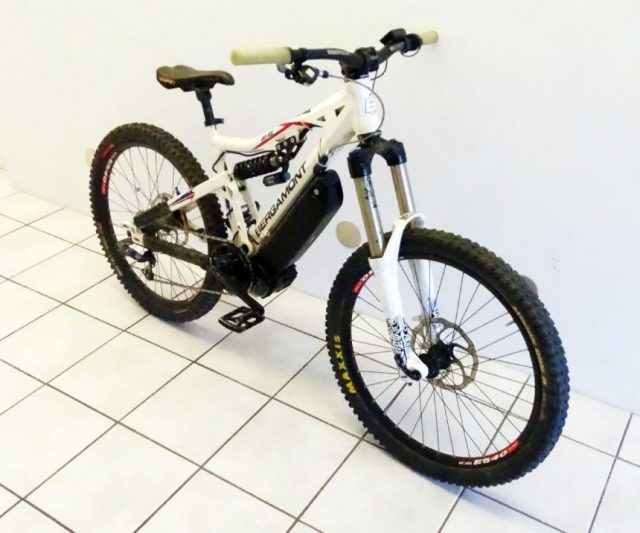
Umbau Bafang Bergamont 1000W

Industry associations warn about retrofit conversions

According to experts cited in the original article, online suppliers of conversion kits often provide customers with insufficient information. Industry associations have published guidance on this subject, including material available from the Zedler Group.

Discussions on forums and online platforms frequently concern the permissible 250 W continuous rated power. Some participants even suggest that a motor’s peak output can be unlimited. Can that really be assumed?

Some articles compare the output of Bafang BBS motors with manufacturer specifications for Bosch, Brose or Shimano systems in vehicles belonging to category L1, and suggest applying UNECE Regulation No. 85 directly to private conversions. They often fail to explain how the proposed measurement would actually be performed.

UNECE Regulation No. 85 sets out requirements and measurement procedures for relevant vehicle propulsion systems. Its application and the appropriate assessment procedure depend on the vehicle and the regulatory context.

The source article refers to manufacturers’ laboratory measurements, checks by technical services such as TÜV or DEKRA, and approvals by Germany’s Federal Motor Transport Authority (KBA) in relevant approval procedures.

It also cites production pedelecs using related Bafang motor technology, including models marketed by Fischer, Prophete and NCM. The original reference links are:

Motor components alone do not necessarily require the same documentation as a complete vehicle subjected to a specific type-approval procedure. The requirements for a finished conversion must be considered separately.

The original article also discusses the sourcing of retrofit components through overseas traders and online marketplaces, including Alibaba and AliExpress, and storage facilities within the European Union. Such supply routes do not, by themselves, establish whether a particular product or transaction complies with tax and product-safety requirements.

Editorial note: This is a translation of an older source article. Historical claims about market practices and approvals should be verified before publication.

Bafang BBS Fact Check: Is Vehicle Approval Required?

Bafang BBSHD

Determining power output of Bafang BBS DIY motors under UNECE Regulation No. 85

UNECE Regulation No. 85 is used in specified vehicle approval contexts. In those procedures, manufacturers determine relevant technical specifications and technical services may verify the results. The German Federal Motor Transport Authority (KBA) is involved where the applicable approval process requires it. The manufacturer remains responsible for its declarations and for product-related obligations.

Common misunderstandings about test procedures and continuous rated power

Online discussions sometimes misrepresent the permissible power range and continuous rated power of conversion motors. Some even suggest that unlimited maximum motor output is automatically compatible with exemption from vehicle approval. Is that really the case?

Different claims about continuous rated power have circulated for years, often relying on comparisons between complete production pedelecs from manufacturers such as Bosch, Brose and Shimano and retrofit systems such as the Bafang BBS. Such comparisons can be misleading when the technical systems and regulatory contexts differ.

Technical considerations: motor power and continuous rated power

For brushless DC (BLDC) motors with cadence-based control, electrical input can be estimated using battery voltage and controller current. However, electrical input power is not the same as measured mechanical output or continuous rated power.

In torque-sensing systems, control electronics may permit higher output for a limited time. The source article discusses assessing continuous rated power with reference to the 30-minute method associated with UNECE Regulation No. 85. A defined test procedure and its applicability must be established before drawing conclusions for any specific vehicle.

Manufacturers including Bafang, Bosch, Brose, Fazua, Giant SyncDrive, Mahle, Shimano, Specialized, TQ Systems, Yamaha and ZF use differing motor systems and control strategies. Their electrical and mechanical specifications cannot be equated without considering operating conditions and measurement methods.

The German source article states that Bafang BBS motors with UART interfaces were fitted to some production bicycles sold by brands such as Fischer, Prophete and NCM until around 2021. It also discusses the possibility of altering controller speed, current and throttle settings in UART systems and historical changes in market distribution. Those historical claims should be checked against primary sources before publication.

What a retrofit kit’s documentation does—and does not—prove

An electromagnetic compatibility (EMC) declaration for individual components does not, on its own, establish the conformity or legal classification of a completed bicycle conversion. The vehicle’s actual configuration and all applicable obligations must be assessed.

The original article advises purchasers to ask the seller what evidence supports claims that a specific conversion is exempt from motor-vehicle approval requirements. Simply reprogramming a Bafang BBS controller according to advice from forums, social media or dealers does not, by itself, provide a complete technical or legal assessment.

Professional assessments should take account of the motor, controller, installation, continuous rated power, assistance limits and the condition of the finished vehicle.

Editorial note: This translation preserves the article’s main argument while clarifying the distinction between electrical input and mechanical output. Legal and historical assertions require editorial verification before publication.

Bafang BBS DIY Conversions in Everyday Use: Inspections, Accidents and the GutRad StVO Module

Converting a Bafang BBS yourself — what happens next?

Converting an ordinary bicycle with a Bafang BBS produces a capable electrically assisted vehicle. DIY converters often start with the hardware: fit the motor, connect the battery, configure the controller and ride. But everyday use raises another question: How can the drive system’s actual operating state be established if the bicycle is inspected, involved in an accident or subjected to expert technical examination?

That is precisely where a single programming operation differs from a system that checks its intended configuration every time it starts.

A DIY conversion is not automatically illegal

A privately converted bicycle does not become a motor vehicle requiring approval simply because a Bafang BBS motor was retrofitted. The actual characteristics of the finished vehicle are decisive.

Essential pedelec characteristics include:

  • rated continuous power of no more than 250 W;
  • motor assistance only during the intended pedalling operation;
  • assistance that decreases progressively as speed rises;
  • assistance ending no later than 25 km/h.

Starting or walk assistance up to 6 km/h is treated separately. The determining factor is not the motor label but the way the complete system actually behaves.

Why programming once is not equally informative

Many Bafang BBS UART systems can be programmed using readily available tools. This allows a particular operating state to be set at first. The practical question is: What happens when relevant controller parameters are changed again later? A screenshot of programming software or a 250 W sticker cannot prevent a subsequent change.

What is different about the GutRad StVO Module?

The GutRad StVO Module establishes a defined GutRad parameter set for compatible Bafang BBS UART systems. It saves the existing controller data before the initial adjustment. At every startup, the relevant controller data are checked again. If deviations are found, the module rewrites the affected values using the stored GutRad set. A change to monitored parameters does not simply remain as the permanent new operating state.

Inspections and expert reports: the actual state matters

During an ordinary ride, few people are interested in how a controller is programmed internally. The situation can be different after an accident, during a technical examination or if there are specific doubts about the bicycle’s configuration. Its actual characteristics and the ability to reconstruct the drive system’s state may then be relevant.

GutRad documentation does not replace expert examination or itself exempt a vehicle from approval. It documents the operating state established and monitored by the GutRad system for the compatible drive.

The GutRad Key is not a hidden off-road switch

Online discussions occasionally suggest that the Key switches between road mode and an unrestricted tuning mode. That is not the function of the GutRad Key. The Key is not required for the module’s intended everyday operation. Its purpose includes restoring controller data saved before installation when the module is removed, for example if a buyer does not wish to keep it.

For users who wish to keep the module permanently

For permanent use, the initially saved controller data can be replaced with the GutRad StVO data set. The backup will then contain only the GutRad configuration. Previous unrestricted or deviating settings can no longer be restored from that backup.

What happens if a converted bicycle is sold?

Passing on or selling a self-converted bicycle is legally and technically different from using one’s own conversion privately. Depending on how the vehicle is supplied, the extent of the modification and especially whether it is offered commercially, additional product- and safety-law obligations may apply.

The question of a sale must therefore not be confused with whether a privately used conversion can qualify as a pedelec. The converter or other responsible party remains accountable for the individually converted whole vehicle.

Responsibility stays with the converter

The GutRad StVO Module is not official vehicle approval. GutRad is not responsible for the frame, brakes, wheels, installation or any other technical characteristics of the complete converted bicycle. GutRad documents the operating state its system establishes and monitors for the compatible drive — no more and no less.

In practical use since 2019

The GutRad StVO Module has been offered since 2019. Based on feedback and experience available to GutRad, we are not aware of a case since launch in which a qualified inspector or technical expert objected specifically to the functioning of a properly used module. This experience is neither government approval, a court ruling nor a legal guarantee.

What does this mean in everyday use?

Anyone converting a Bafang BBS bicycle must decide how to deal with the technical responsibility for the conversion. The StVO Module offers a defined technical basis:

  • back up the controller state before adjustment;
  • apply the GutRad parameter set;
  • check relevant values at every startup;
  • overwrite detected deviations;
  • enable removal and restoration through the GutRad Key;
  • document the operating state monitored by the module.

This does not remove the converter’s responsibility. It is a technical way to make an important part of that responsibility more transparent.

More about the GutRad StVO Module

  • GutRad StVO Module: Function, Monitoring and Responsibility
  • How the GutRad StVO Module works technically
  • Bafang BBS DIY conversion: Pedelec Status and Responsibility
  • GutRad StVO Module in the shop

This article offers general technical and legal information; it does not replace individual legal advice or technical assessment of a specific vehicle.

Bafang BBS CAN Bus and Open Conversion Systems: Technical Context

Why Bafang does not factory-limit its BBS motors to EN 15194

Bafang’s approach to the BBS01, BBS02 and BBSHD is shaped by economic, technical and market-specific considerations, rather than exclusively by the European EN 15194 standard.

🔧 1. The BBS is a global DIY conversion motor

Bafang markets the BBS series worldwide, not only in the European Union.

  • Many countries, including the United States, Canada and Australia, have different requirements and limits.
  • In North America, e-bikes rated at 750 W or more are permitted in certain regulatory categories; power is a selling point in those markets.
  • The motor is expressly offered for the DIY conversion market, where it is installed on existing bicycles.

➡️ A factory-installed EU-specific lock would restrict this international market.

🛠️ 2. Software that dealers and OEMs can configure

Bafang supplies the BBS as an OEM component (Original Equipment Manufacturer).

  • Dealers or brands can adapt settings and limits, for example through a display or configuration software.
  • The article’s position is that responsibility for the conformity of a finished vehicle lies with the party placing that vehicle on the market, rather than automatically with the supplier of an individual motor.

➡️ The motor is intended as a base component, not necessarily as a complete, ready-to-use EPAC system.


⚠️ 3. No single worldwide requirement to limit every motor to 250 W

  • EN 15194 addresses complete electrically power-assisted cycles (EPACs), rather than treating an individual motor as a complete bicycle.
  • A motor manufacturer does not necessarily determine conformity for every possible installation. The manufacturer or party placing the complete vehicle on the market has corresponding responsibilities.

➡️ Where Bafang sells a motor as a component rather than placing a finished bicycle on the market itself, the requirements must be assessed in the context of that product and its intended use.

📦 4. Product range built on a common platform

The BBS range includes versions with different marketed power ratings:

  • BBS01B: 250 W
  • BBS02B: 500–750 W
  • BBSHD: 1,000 W and above

The article describes differences particularly in controller parameters and stator winding configurations, while referring to a shared software concept.

➡️ A common, configurable platform may be more economical than producing numerous permanently restricted versions.

✅ Conclusion

According to the article, Bafang does not restrict the entire BBS range to an EU-specific configuration because the motors are sold globally, are intended as configurable OEM components and are used in differing legal environments.

For use on German roads, the finished bicycle must meet the applicable legal criteria. An additional technical limitation and monitoring solution such as the GutRad StVO Module is intended to help achieve a defined pedelec operating configuration on compatible BBS UART systems. The module itself is not a vehicle approval.

Will Bafang BBS Conversion Kits Face Stricter Inspections?

Bafang E-Bike

Will Bafang BBS conversion kits face more enforcement in the future?

The article’s answer is: yes.

How can you recognise a conversion kit that may require vehicle approval?

If a bicycle conversion kit carries CE marking only in relation to electromagnetic compatibility (EMC), rather than for the finished bicycle, this may indicate that additional requirements have not been established for the complete converted vehicle. In the context described here, the CE marking of a Bafang BBS DIY motor principally relates to electromagnetic compatibility.

Additional provisions may apply to a complete electrically assisted bicycle and to the parts or assemblies placed on the market, depending on the product’s actual characteristics. These may include machinery and other relevant product-safety requirements.

The absence of valid, applicable conformity documentation can be a warning sign. Consumers should then ask the manufacturer or seller for clarification, and may also contact the competent authorities.

Operating a vehicle outside the bicycle category

Operating a vehicle that requires registration or approval without complying with the applicable requirements may give rise to administrative offences or even criminal liability. The article criticises statements suggesting that motor power cannot meaningfully be measured and that unrestricted use is therefore lawful.

If an investigation takes place, the actual performance of the drive system and any documentation supporting it can become important. Incorrect statements or a lack of suitable evidence may have serious consequences.

The end user or person placing the converted vehicle into service remains responsible for its actual configuration. Confirmation from a seller concerning the motor or system’s performance may be useful evidence, but it does not replace the assessment of the entire vehicle. Without an invoice, suitable technical confirmation, installation documentation or specifications, explaining the system’s actual configuration during an inspection or after an incident can be difficult.

Verified sources: enforcement and regulatory initiatives

The following sources distinguish government consultations, police inspections and industry positions. None, by itself, demonstrates that a particular converted bicycle is legally classified as a motor vehicle.

Technical distinction: A bicycle’s legal classification depends on its actual characteristics, including rated continuous motor power, pedal-dependent assistance and assistance cut-off. A roadside assistance cut-off test is not the same thing as a mechanical power measurement, a product conformity assessment or vehicle approval.

Source review: 16 November 2026. Where available, official sources replace older press reports. The original article also cited other 2024 media reports as historical examples; those reports are not presented here as independently verified.

GutRad’s approach

As the debate about e-bike conversion kits intensifies, GutRad’s stated aim is to offer technical solutions for the European market. Users who want to operate a Bafang BBS DIY conversion without vehicle registration must be able to establish that the finished vehicle meets the applicable criteria. Suitable performance documentation can help establish the operating characteristics.

Editorial note: Some claims and examples in the original article are time-specific. Before publication on LIVE, the cited enforcement cases, applicable legal provisions and source links should be checked against current primary sources.